
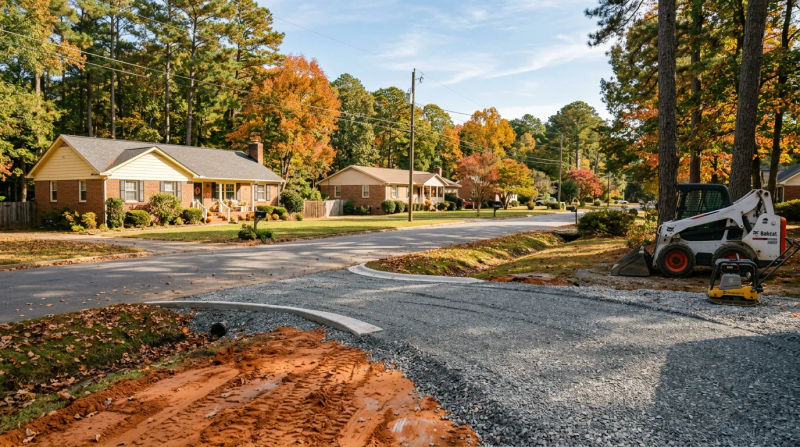
As an excavation and grading foreman who has spent the last 14 years working around Goldsboro and New Hope, I’ve seen firsthand what our local soil can do to a poorly built driveway. Here in New Hope, many properties sit on clay-heavy soils that hold water like a sponge. When a driveway base isn't built to handle this reality, it leads to constant problems: ruts, potholes, and a muddy mess every time it rains. It’s a frustrating cycle for homeowners.
October, with its cooler, drier air, is one of my favorite times of year for this kind of work. It gives us a prime window to shape the grade and compact the base before the wetter winter weather sets in. At LRC Excavating and Grading, we use this season to correct driveway issues so they drain cleanly and hold up through late-season storms and beyond. This guide explains how we approach driveway construction differently in New Hope to create a surface that lasts.
New Hope Weather Challenges
Our North Carolina climate is beautiful, but it's tough on infrastructure. The combination of hot, humid summers and periods of heavy rain puts immense stress on any driveway. The core of the problem lies right beneath the surface: the clay soil.
Clay soil expands when it gets saturated with water and shrinks as it dries. This constant movement, even on a microscopic level, destabilizes anything built on top of it. When a driveway base is too thin or isn't separated from the clay, a few things happen:
- Water Saturation: During a heavy downpour, water soaks through the gravel and gets trapped in the clay subgrade. The base becomes soft and spongy, losing its strength.
- Rutting and Potholes: When you drive over this saturated base, the weight of your vehicle easily displaces the stone and pushes it down into the soft clay. This is how ruts and potholes are born. The stone disappears into the mud, and the surface deforms.
- Winter Woes: While our winters are milder than up north, we still get freeze-thaw cycles. Water trapped in the driveway base freezes, expands, and pushes the gravel apart. When it thaws, it leaves behind a weakened, unstable surface that’s prone to failure.
Over the years, the team at LRC Excavating and Grading has been called out to fix countless driveways suffering from these exact issues. The common thread is almost always a failure in the initial driveway base prep.
Best Practices for Local Homeowners
A long-lasting driveway isn't about the gravel you see on top; it's about the foundation you can't see. Building that foundation correctly involves a few non-negotiable steps, especially in our area.
1. Proper Excavation (Undercutting) Before any stone goes down, you have to remove the topsoil and any soft, unstable clay beneath it. Simply scraping the grass off isn't enough. We typically undercut 8 to 12 inches to get down to a firm, stable subgrade. This removes the organic material that will decompose and create soft spots.
2. Geotextile Fabric is a Game-Changer This is a step that gets skipped far too often to save a few dollars, but it's critical for longevity on clay soil. We always recommend laying down geotextile fabric under gravel driveway installations. This woven material acts as a barrier, separating your clean stone base from the clay subgrade. It does two crucial things:
- It prevents your expensive gravel from being pushed down and lost into the mud.
- It adds tensile strength and helps distribute the load of traffic over a wider area, reducing stress on the subgrade.
3. The Right Base Depth and Compaction The New Hope NC gravel driveway base depth is a critical factor. For a standard residential driveway, we recommend a minimum of 6-8 inches of compacted aggregate base course (ABC) stone. This stone is a mix of crushed rock and fines that lock together tightly when compacted. We install it in 3-4 inch “lifts,” watering and compacting each layer with a heavy vibratory roller before adding the next. This process creates a dense, stable, and water-resistant foundation.
4. Effective Drainage: Crown and Ditch Water is the enemy of any driveway. You have to give it a place to go. That’s why proper driveway grading crown and ditch New Hope is so important. We build every driveway with a slight “crown” - an arch in the center that’s about 2% higher than the edges. This gentle slope encourages water to run off to the sides instead of pooling in the middle. We then grade shallow swales or ditches along the sides to carry that water away from the driveway and into a safe area.
Local Resources and References
Many of us in the New Hope area live in those classic single-story brick ranch homes built in the 1970s. These homes are staples of our community, often situated on large lots with long driveways. A failing driveway doesn't just look bad; it can detract from the entire property. Getting the foundation right is an investment in your home's curb appeal and functionality.
While our crews at LRC Excavating and Grading source our geotextile fabric and stone from commercial suppliers to ensure consistent quality, homeowners looking to tackle a small walkway or shed foundation can find the necessary tools nearby. You can grab quality shovels, wheelbarrows, and landscape fabrics at places like Lowe's Home Improvement or find good deals on hand tools at Harbor Freight, both just a short drive away. Understanding the right process is just as important as having the right tools.
Choosing a Local Expert
I’ve seen what happens when these steps are rushed or skipped. A new driveway might look great for a few months, but without a proper foundation, it won't be long before the ruts and potholes reappear. The difference between a driveway that lasts three years and one that lasts twenty is in the details of the preparation.
That’s where experience with local conditions makes all the difference. Our trained crews understand the challenges of New Hope’s soil. We have organized workflows and standardized processes to ensure every project, big or small, is built on a solid foundation. From the initial site assessment to the final grade, we focus on reliability and expertise. We know that doing it right the first time saves you money and headaches in the long run.
Your Local Driveway Experts
Building a driveway that can withstand New Hope's weather and soil isn't complicated, but it does require a commitment to doing things the right way. It starts with proper excavation, includes a stabilizing fabric barrier, relies on a deeply compacted stone base, and finishes with grading that sheds water effectively.
If you're tired of patching the same potholes every year or dealing with a muddy, rutted driveway, it might be time to address the foundation. When it comes to driveway excavation and grading in New Hope, LRC Excavating and Grading has the local expertise and professional equipment to build it right, from the ground up. Feel free to reach out to our team for an assessment of your property.