
I got the call on a soggy Tuesday in late September. It’s a time of year I know well here in North Carolina - the air is still thick with humidity, and the ground is often saturated from the remnants of late-season tropical storms. The homeowner on the other end of the line sounded frustrated, and I could understand why. His family had a beautiful home in Cary, but their backyard was a swamp. Every time a heavy rain came through, water would pool for days, turning the lawn into a muddy pit the kids couldn't play in and the dogs couldn't use without tracking grime all through the house.
This is a story my team at LRC Excavating and Grading hears all too often, especially in Cary neighborhoods. Many of the homes, built in the late 1990s and early 2000s, are large and feature complex, multi-gabled rooflines. While beautiful, these roofs act as massive funnels, collecting huge volumes of water and dumping it into just a few downspout locations. If the yard wasn't graded perfectly from the start, all that water has nowhere to go. With tight lot lines common in the area, the problem is only magnified. The homeowner knew he needed a professional solution, not just another temporary fix. That’s when he called us.
The Assessment
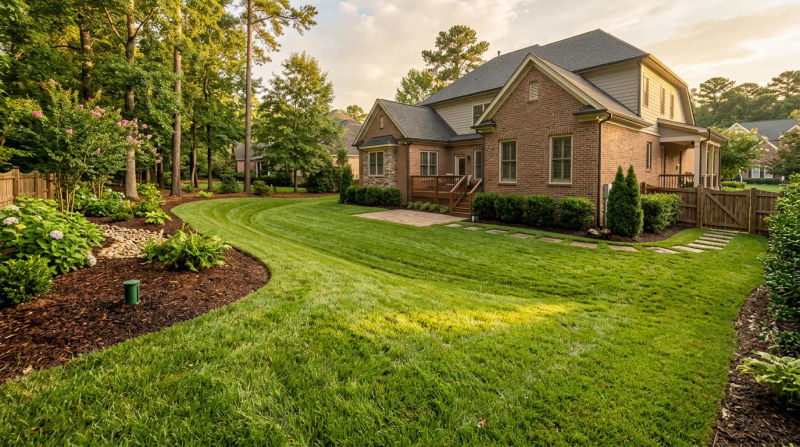
When I arrived at the property, I saw the problem firsthand. The house was a classic example of the era: a large two-story design with a mix of brick and siding. The backyard wasn't huge, but it had great potential. Unfortunately, a significant portion of it was unusable. A soupy, standing pool of water sat about twenty feet from the back patio, and the ground felt like a sponge under my boots. You could see the stress lines in the grass where it was struggling to survive.
My first step in any standing water drainage grading Cary project is to understand precisely how water is moving - or in this case, not moving. I pulled out my laser transit and started taking elevation shots across the entire yard. The data confirmed my suspicions. There were two major issues:
- Negative Grade: In the corner nearest the main downspout, the ground was actually sloping back towards the home's foundation. This is a dangerous situation that can lead to moisture in the crawlspace or basement and long-term structural damage.
- A Central 'Bowl': The middle of the yard had settled over the years, creating a shallow depression. With no clear exit path, any water that flowed off the patio or away from the house simply collected in this low spot and stayed there until it slowly evaporated or soaked in, keeping the ground perpetually saturated.
The challenge was clear. We needed to perform a comprehensive backyard regrading to create positive drainage, directing all water away from the foundation and toward a designated runoff area at the property's edge. The tight space between the houses meant we had to be precise; there was no room for error. I explained to the homeowner that this wasn't about digging a trench, but about subtly re-shaping his entire yard to work with gravity, not against it. He was relieved to hear a concrete plan, and he gave LRC Excavating and Grading the green light to proceed.
Our Solution
Our approach for this Cary backyard regrading project was centered on precision, efficiency, and using the right materials. My 3-person crew at LRC Excavating and Grading mobilized the following Monday, ready to transform the space in just a few days.
Our primary piece of equipment for this job was a compact track loader. Its rubber tracks distribute weight evenly, minimizing damage to the driveway and surrounding lawn, which is essential when working on established properties. We began by carefully stripping the existing, damaged sod and soil from the affected areas and setting it aside.
With a clean slate, the real work of swale and slope correction Cary homeowners need could begin. The process followed a few key steps:
- Building the Foundation Grade: The most critical area is the 10-foot zone around the house. We brought in a specialized mix of screened topsoil and sand, which drains much better than the dense clay common in the region. Using the laser level for constant guidance, we built up the grade against the foundation to create a consistent, definite slope away from the home. This step alone ensures that water immediately moves away from the structure.
- Sculpting the Swale: Instead of an ugly, deep ditch, we created a broad, shallow swale. Think of it as a very gentle, wide valley in the lawn. This swale was engineered to capture all the water from the downspouts and the newly graded yard and guide it gracefully toward the back of the property line where a natural drainage area existed. We shaped it to be almost unnoticeable, ensuring the homeowner would still have a flat, usable lawn that was easy to mow.
- The Final Grade & Finish: Once the primary shapes were established, we used a Harley Rake attachment on our loader. This tool is fantastic for the final pass, as it churns the top layer of soil, removing clumps and rocks, and leaving behind a perfectly smooth, fluffy seedbed. This meticulous finish work is a point of pride for the LRC Excavating and Grading team. It not only looks professional but also gives the new grass seed the best possible chance to thrive.
The entire process, from stripping the old lawn to the final raking, was completed in just two days. We believe in working efficiently to minimize disruption for the homeowner and their neighbors.
The Results
The transformation was immediate and dramatic. Where there was once a muddy bowl, there was now a smooth, gently contoured yard that looked bigger and more inviting. The homeowner was thrilled with the look, but the real test came a week later when a classic North Carolina thunderstorm rolled through and dropped over an inch of rain in an hour.
He called me the next morning, not with a problem, but with excitement in his voice. He said he watched from his back window as the water flowed exactly as planned - away from the house, into the subtle swale, and off the property. By the time the rain stopped, the yard was wet, but there was zero standing water. For the first time, his kids could go outside and play shortly after a storm.
He told me, "You guys at LRC Excavating and Grading didn't just fix a drainage problem; you gave us our backyard back." That’s the kind of feedback that makes this job so rewarding. The long-term results are just as important: his home's foundation is now protected from water damage, his new lawn is growing in thick and healthy, and his property value has increased. This project is a perfect example of how a well-executed grading plan can permanently solve issues that plague so many homeowners.
If your yard turns into a pond after every rain, you don't have to live with it. A professional assessment and a proper grading solution can make all the difference, giving you back a safe, dry, and usable outdoor space.
Ready for your own LRC Excavating and Grading experience? Contact us today for a free inspection.