
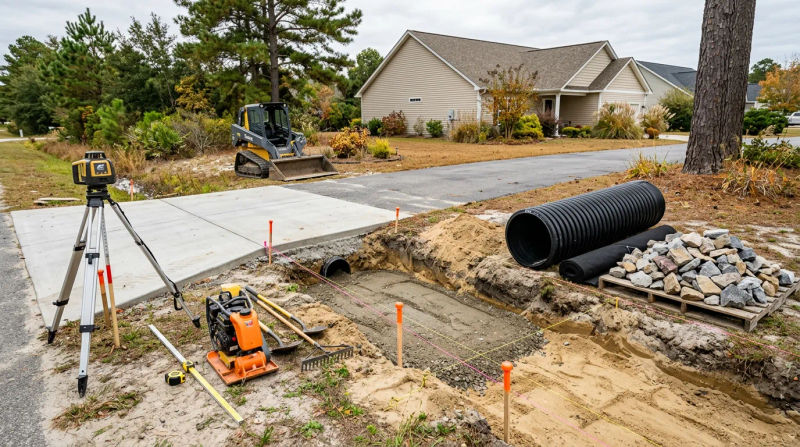
When you need a new driveway entrance or have to replace a failing ditch pipe, one of the first questions on your mind is always, "What's this going to cost?" As a foreman who’s been running excavation crews for over 14 years, I can tell you that it's a valid question with a complex answer. The price of a driveway culvert installation isn't just about a piece of pipe; it’s about the entire system that keeps water flowing and your property accessible.
Here in the Jacksonville area, we get our fair share of sudden, heavy downpours. A properly installed culvert is your first line of defense against washout, pooling water, and a soggy driveway. With the cooler temperatures of October upon us, now is the perfect time to plan these access improvements. My goal here is to give you a transparent look at the costs involved so you can budget effectively and know what to expect before the first bucket of dirt is moved.
Average Costs in Jacksonville
Let’s get right to it. Providing a flat rate is impossible, but based on my experience, I can give you some realistic ranges for what a professional installation typically costs in our area. The Jacksonville driveway culvert price depends heavily on whether it's a simple replacement or a full new installation with significant earthwork.
- Simple Culvert Replacement: For a straightforward swap of an existing, properly sized culvert of about 20-24 feet, you can generally expect the cost to be in the $1,800 to $3,500 range. This assumes the existing ditch grade is good, access is easy, and no major regrading is needed. This price typically includes the new pipe (usually a standard HDPE pipe), excavation of the old pipe, setting the new one, and backfilling with appropriate material.
- New Culvert Installation with Grading: If you're creating a new driveway entrance or if the existing ditch needs to be reshaped, the cost will be higher. For a new installation, the cost to install driveway pipe in Jacksonville often falls between $3,500 and $8,000+. This wider range accounts for more extensive excavation, establishing the correct grade for water flow, potentially using larger or longer pipes, and bringing in materials for the driveway base over the new pipe.
In many of Jacksonville's neighborhoods with homes built in the 1950s, we often find that the original drainage solutions are no longer adequate. The ditches may have silted in over 70 years, or the original, smaller metal pipes have rusted out. In these cases, the project often leans toward the higher end of the cost spectrum because our crews need to re-establish the entire drainage path, not just replace a pipe.
Factors That Affect Price
The final culvert installation cost is a sum of several parts. Understanding these variables will help you see where your money is going and why one quote might be different from another.
- Pipe Material, Diameter, and Length: The pipe itself is a major cost driver. Corrugated metal is often the cheapest, but it can rust. Concrete is durable but heavy and expensive to transport and install. Our crews typically recommend double-wall HDPE (High-Density Polyethylene) pipe. It has a smooth interior for excellent flow and a corrugated exterior for strength, and it won't rust. A larger diameter or longer pipe will naturally cost more but is essential for handling the water volume from heavy Jacksonville rains.
- Excavation & Site Access: The amount of digging is a direct factor in labor and equipment time. Is the area clear, or do we need to remove trees, stumps, or large rocks? Is the site easily accessible for an excavator and dump truck, or is it a tight space that requires more manual labor and smaller machines? Difficult access increases time and cost.
- Grading, Backfill, and Compaction: This is where expertise truly matters. A culvert set at the wrong angle won't drain. Our technicians spend significant time ensuring the trench bottom has a consistent, positive slope. The material used to backfill around the pipe is also critical. We use specific types of gravel and soil, placed in layers and compacted properly, to prevent the pipe from shifting or the road from sinking. This is a key component of culvert permit and grading costs in Jacksonville.
- End Treatments (Headwalls): Simply having a pipe stick out of the ground works, but it’s not ideal. The ends can be crushed by mowers or vehicles. Adding flared end sections, concrete headwalls, or stone riprap stabilizes the soil around the pipe, prevents erosion, and improves water flow into and out of the culvert. These add to the material and labor costs but dramatically increase the longevity and performance of the system.
- Permitting and Inspections: Depending on your location and the ditch system (e.g., if it's a NCDOT-maintained right-of-way), a permit may be required. The process involves applications and inspections to ensure the work meets code. An experienced contractor will know the local requirements and can handle this process for you.
How to Get the Best Value
Getting the best value doesn't mean finding the cheapest price. In excavation, the lowest bid can sometimes lead to the most expensive long-term problems, like a collapsed driveway or a flooded yard. Here’s how to be a smart buyer.
- Insist on an Itemized Quote: A professional contractor should be able to break down the costs for you. A quote that lists pipe costs, labor, equipment time, and materials separately allows you to compare different bids accurately. It shows transparency and helps you understand exactly what you're paying for.
- Don't Skimp on the Pipe: As I mentioned, the pipe material matters. Paying a little more for a high-quality HDPE pipe today can save you from having to pay for a full replacement again in 10-15 years.
- Think About the Whole System: Consider the driveway surface. If you plan to pave with asphalt or concrete soon, make sure the culvert work includes a properly compacted base of gravel (like ABC stone) that's ready for the pavers. Bundling the grading work can save costs later.
- Ask About Spoil Removal: What happens to the dirt and old pipe that's excavated? Will it be hauled away or can it be used to grade another area of your property? Clarifying this upfront avoids surprise charges.
Questions to Ask Your Contractor
Before you hire anyone, arm yourself with a few key questions. The answers will reveal a lot about their experience and process.
- How do you determine the right pipe diameter and slope for my specific property? (The answer should involve assessing the watershed area and the ditch's characteristics.)
- What type of backfill material do you use around the pipe, and how do you compact it? (Look for answers that mention specific gravel types and compaction in lifts/layers.)
- Will this project require a permit, and if so, do you manage the application and inspection process?
- What steps will you take to protect my lawn and existing driveway from damage during the work?
- Can you provide a detailed, itemized estimate?
From my years in the field, I can tell you that a contractor who can answer these questions confidently and clearly is one who understands the job beyond just digging a trench. Organized workflows and standardized processes are the bedrock of a reliable excavation project.
Ultimately, installing a driveway culvert is an investment in your property's safety, function, and value. While the initial culvert installation cost is a key consideration, the quality of the work is what ensures that investment pays off for decades to come. Taking the time to understand the factors and hire a qualified team will prevent costly headaches down the road. For a personalized estimate in Jacksonville that breaks down every aspect of the job, contact LRC Excavating and Grading for a free consultation.