
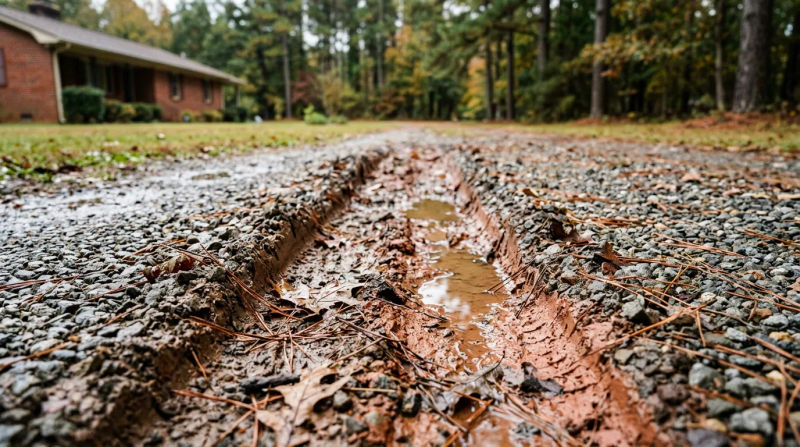
That familiar, jarring bump and shudder as you pull into your driveway after a good rain is a feeling many of us know too well. You steer to avoid the puddle from yesterday, only to have your tires sink into a soft spot you didn't see. For many homeowners in the Brogden area, a gravel or older asphalt driveway can feel like a constant battle against the elements. After 14 years running excavation crews, I've seen firsthand how our coastal plain soil and heavy rains can turn a minor depression into a major headache.
The good news is that these issues are almost always fixable. The key is understanding what you're seeing and addressing the root cause, not just the symptom. With the cooler, drier weather of October upon us, now is the perfect window to assess your driveway's condition and perform a proper driveway regrading before the late-fall and winter rains set in and make matters worse.
Common Signs and Symptoms
A driveway that needs attention will give you plenty of warning signs. The trick is to know what to look for beyond the obvious. When our technicians evaluate a property, these are the key indicators we're trained to spot:
- Deep Ruts and Channels: This is the most common complaint, especially for gravel driveway ruts Brogden residents face. These are more than just tire tracks; they are channels that trap water, preventing it from shedding off the surface. With each vehicle pass, the water is displaced, eroding the channel deeper and wider.
- Persistent Standing Water: A properly graded driveway should act like a roof, directing water away from its surface and away from your home's foundation. If you have puddles that linger for hours or days after a storm, it's a clear sign of low spots where the grade has failed.
- Washboarding or Ripples: On gravel and dirt surfaces, you may feel a series of small, rhythmic bumps. This is often called "washboarding." It's caused by the spinning and bouncing of tires over time, especially during acceleration or braking, which displaces the surface material into a ripple pattern.
- Driveway Soft Spots After Rain: If you notice areas that feel spongy, mushy, or where your tires sink in after precipitation, you're likely dealing with a bigger issue. These driveway soft spots after rain indicate that water has penetrated the surface and saturated the sub-base, compromising its ability to support weight.
- Eroding Edges: Is your gravel washing away into the lawn? Are the edges of your driveway crumbling? This signifies that water is running off the sides too quickly and with too much force, taking your driveway material with it.
- Loss of Crown: A professionally installed driveway has a slight arch or peak in the center, called a crown. This subtle slope, often just a quarter-inch per foot, is critical for encouraging water to run off to the sides. Over time, traffic and settling can flatten this crown, allowing water to pool in the center.
- Weed Growth in Driving Lanes: Weeds are opportunistic. They thrive where water and fine sediment collect. If you see lines of weeds growing where you drive, it’s a tell-tale sign that those areas have become low spots that hold moisture.
What Causes This Problem
Understanding the cause is the first step in finding a lasting solution. Driveway problems are rarely just surface-level; they typically point to a foundational issue. In my experience, the culprits are usually a combination of the following:
1. Sub-Base Failure: The layers of compacted stone and soil beneath your driveway's surface are its foundation. In low-lying parts of the coastal plain like Brogden, a heavy rain can saturate the ground. If the sub-base wasn't properly compacted or is made of the wrong material, it will soften and lose its structural integrity. Traffic then easily creates ruts and soft spots.
2. Poor Initial Grading and Compaction: A driveway is only as good as the prep work that went into it. If the original installation didn't establish a proper crown for drainage or if the base layers weren't compacted correctly, the driveway was destined to fail prematurely. Many of the beautiful 1950s ranch homes in our area sit on generous lots, but their driveways may have been installed decades ago with different standards and have settled significantly over time.
3. Water Intrusion: Water is the number one enemy of any driveway. It erodes material, weakens the base, and, in winter, can freeze and expand, breaking apart the surface. Without proper grading to control it, water will always find the path of least resistance, carving channels and creating puddles.
4. Organic Material: If topsoil, roots, or other organic matter were left in the sub-base during construction, they will eventually decompose. This creates voids beneath the surface, leading to sinking and collapse.
When to Call a Professional
It can be tempting to grab a few bags of gravel from the hardware store and fill in the ruts yourself. While this might provide a temporary visual fix, it rarely solves the problem. In most cases, you're just putting a bandage on a wound that needs stitches.
Patching a rut without addressing the failed base and poor drainage underneath means the new material will soon be pushed aside or sink into the mud, and you'll be right back where you started. The answer to how to fix driveway washboarding or deep ruts isn't more material - it's restoring the grade and ensuring a solid, compacted base.
A professional driveway regrading is necessary when:
- You have widespread issues like multiple ruts, washboarding, or large areas of standing water.
- The problem returns quickly after you attempt a DIY fix.
- You have significant driveway soft spots after rain, indicating a compromised base.
- Water is draining toward your garage or home foundation, risking costly structural damage.
An experienced crew approaches this systematically. Our process involves using a skid steer or tractor with a grading blade to reshape the entire surface. We re-establish the critical crown and ensure a consistent slope away from buildings. If the base has failed, we may need to excavate the soft material, bring in new structural fill, and compact it in layers with heavy machinery to create a solid foundation that will last for years.
Conclusion
Your driveway is more than just a place to park; it’s a functional part of your property that affects curb appeal, safety, and cleanliness. The ruts, puddles, and soft spots you see today are signs of an underlying grading and drainage problem. Simply filling them in is a short-term fix for a long-term issue.
By addressing the root cause with proper regrading, you're not just smoothing out the bumps - you're investing in a stable, durable surface that can withstand our local weather patterns. Acting now, during the drier autumn months, can prevent winter rains from causing further erosion and turning a manageable repair into a major reconstruction project.
If you notice any of these signs, contact a local excavation contractor for an inspection. A qualified professional can assess the condition of your driveway's base and surface to recommend a lasting solution.